


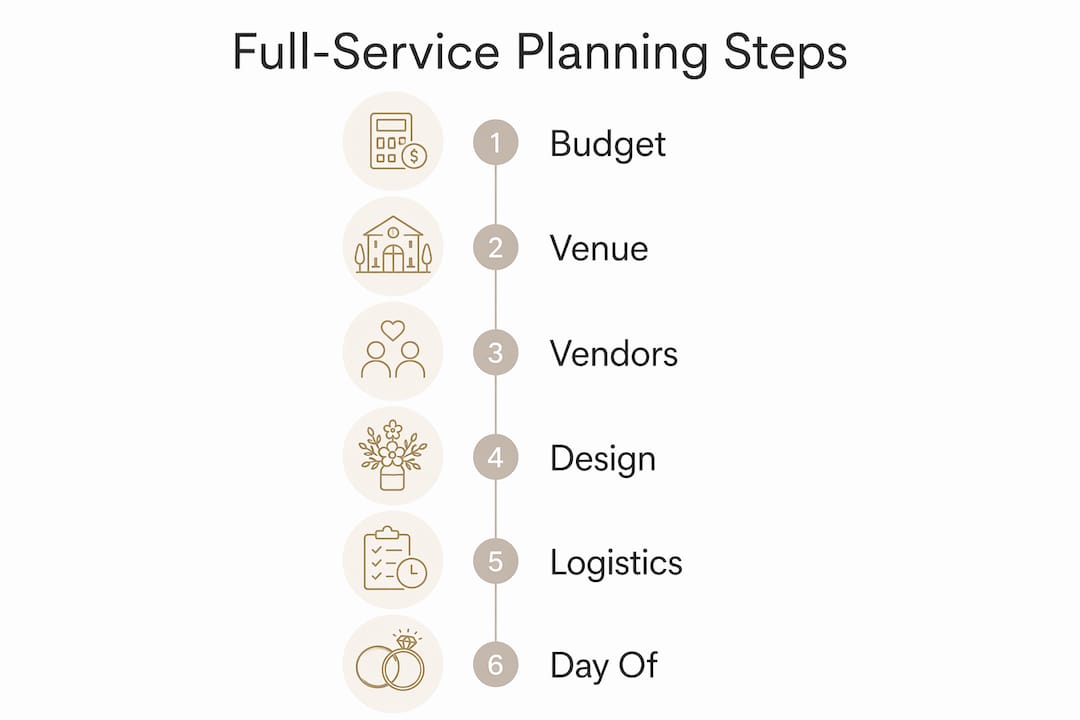
Full-service wedding planning is defined as end-to-end management of every major component of your wedding, from the first budget conversation to the final vendor payment on the day itself. What does full-service planning include? Budget development, venue sourcing, vendor curation, design direction, logistical coordination, and on-site execution. For couples planning a destination wedding in Sicily or anywhere abroad, this level of support is not a luxury add-on. It is the difference between a wedding that reflects your vision and one that reflects whoever was available at the last minute.
Most couples discover quickly that planning a wedding from a distance involves far more moving parts than they anticipated. A planner in Sicily does not just book a venue. She manages a network of photographers, florists, caterers, musicians, and civil ceremony officials, all while keeping your budget on track and your stress levels low. Sicilianweddingandevent, led by Tania Costantino, offers exactly this kind of full-service planning for international couples who want an authentic, well-executed Sicilian wedding without the chaos of managing it alone.
What does full-service planning include at its core?
Full-service planning covers budget development, venue selection, vendor curation, design direction, logistical planning, and wedding day coordination. That is the formal definition used across the industry. Each of those categories contains far more detail than the label suggests, and understanding each one helps you know exactly what you are paying for.
Budget planning and ongoing tracking
A full-service planner builds your budget from scratch based on your priorities, guest count, and vision. She tracks every expense as contracts are signed and deposits are paid. This is not a one-time spreadsheet. It is a living document that gets updated throughout the planning process, often 9–18 months before the wedding date.
Venue sourcing and selection
Your planner researches venues that match your aesthetic, guest capacity, and logistical needs. For a destination wedding in Sicily, this means knowing which baroque estates allow outside catering, which clifftop terraces have noise restrictions, and which historic venues require special permits. That local knowledge is not something you can replicate with a Google search.
Vendor curation and contract review
Full-service planners select vendors based on strong, ongoing professional relationships rather than availability or price alone. A planner who has worked with a Sicilian florist for five years gets a different level of service than a couple booking cold. Contract review is included, though it is logistical in nature, not legal advice. Your planner checks timelines, deliverables, and cancellation terms. She does not replace an attorney.
Design direction and aesthetic coordination
Full-service planning integrates design and logistics from the beginning. Your planner works with you to develop a visual concept, then translates that concept into specific choices: linen colors, floral arrangements, table layouts, lighting, and stationery. Every vendor receives a consistent brief so the final result feels cohesive rather than assembled from separate decisions.
Logistical planning and timeline management
Floor plans, transportation schedules, ceremony run-of-show, and reception timelines all fall under this category. For multi-day celebrations, which are common in destination weddings, your planner coordinates overlapping schedules across welcome dinners, ceremonies, and farewell brunches.
Wedding day coordination and rehearsal leadership
On the wedding day, your planner runs the show. She leads the rehearsal, manages vendor arrivals, handles last-minute changes, and keeps the timeline on track. You focus on getting married. She focuses on everything else.
Pro Tip: Ask your planner specifically who will be present on your wedding day. Some planning companies send a junior associate rather than the lead planner. Confirming this detail early prevents surprises.
How does full-service planning compare to partial or month-of coordination?
The three main service levels in the wedding industry are full-service planning, partial planning, and month-of coordination. Each serves a different type of couple with different needs and timelines.
| Service level | When it starts | What it covers | Best for |
|---|---|---|---|
| Full-service planning | 9–18+ months out | Everything from budget to execution | Complex, destination, or high-budget weddings |
| Partial planning | 6–9 months out | Specific phases or tasks the couple needs help with | Couples who have started planning but need expert guidance |
| Month-of coordination | 4–6 weeks out | Final logistics, vendor confirmations, and day-of management | Couples who have planned everything and need execution support |
Planning tiers differ significantly in scope, timeline, and deliverables. Full-service begins early and covers all phases. Partial planning focuses on mid-phase vendor and logistics guidance. Month-of coordination handles only final operations.
The value of full-service over partial planning becomes clearest in two situations. First, when the wedding involves multiple vendors across a destination you do not live in. Second, when the couple has limited time to manage the process themselves. Couples hire full-service planners not because they lack capability, but because they lack available bandwidth. A demanding career, a long-distance relationship, or simply the complexity of a Sicilian destination wedding makes full-service the practical choice, not just the premium one.
Partial planning works well for couples who have already booked their venue and a few key vendors but need help pulling the remaining pieces together. Month-of coordination suits couples who are highly organized, have local knowledge, and simply want a professional to execute on the day. Neither of those scenarios describes most destination wedding couples, who typically need support from the very first decision.
What unique benefits does full-service planning offer for destination weddings?
Destination weddings introduce a layer of complexity that local weddings simply do not have. Centralizing vendor management across time zones and languages is one of the defining advantages of full-service planning for couples marrying abroad.
The specific benefits for destination couples include:
- Centralized communication. Your planner becomes the single point of contact for every vendor in Sicily. You do not manage email threads in Italian at midnight. She does.
- Language and cultural fluency. A local planner understands how Sicilian vendors work, what their contracts actually mean, and how to negotiate terms that protect you. This is not something a translation app can replicate.
- Travel and accommodation coordination. Full-service planning often extends to guest accommodation blocks, airport transfers, and local transportation logistics. Your guests arrive knowing exactly where to go.
- Cohesive design across multiple events. A destination wedding weekend typically includes a welcome dinner, the ceremony, the reception, and sometimes a farewell brunch. Your planner ensures the aesthetic and energy of each event connects to the others.
- Protection of your mental load. Full-service planning relieves the mental load of managing a complex event, allowing you to stay fully present during your wedding weekend rather than becoming a logistics coordinator.
The destination event coordination required for a Sicilian wedding involves permits, local authority relationships, and venue-specific rules that change from property to property. A planner who has worked at Tonnara di Scopello or a baroque estate in the Val di Noto knows those rules in advance. That knowledge prevents delays, avoids costly mistakes, and keeps your timeline intact.
Pro Tip: When interviewing a destination planner, ask how many weddings she has completed at your specific venue or in your target region. Venue-specific experience is worth more than general planning experience.
What are common misconceptions about hiring a full-service wedding planner?
Full-service planning is one of the most misunderstood services in the wedding industry. Setting clear expectations from the start protects both you and your planner.
- Planners do not pay vendors on your behalf. Couples remain financially responsible for all vendor payments. Your planner manages contracts and tracks invoices, but the payments come from your account. This is standard practice across the industry.
- Contract review is not legal advice. Your planner reviews contracts for logistical accuracy: timelines, deliverables, and cancellation policies. She is not a lawyer. If a contract raises legal concerns, consult an attorney.
- On-site presence may not always be the lead planner. Some planning companies assign associates for wedding day management. Ask directly who will be present on your wedding day and get the answer in writing.
- Design revisions have limits. Full-service planning includes design collaboration, but it does not mean unlimited revisions. Most planners define a specific number of concept rounds in their contracts. Know this before you sign.
- You still make the decisions. Full-service planning is a partnership. Your planner presents options, manages execution, and protects your vision. But the key choices, from venue to menu to music, remain yours. The planner’s role is to make those decisions easier and better informed, not to make them for you.
- Full-service planning is not primarily a cost-saving measure. Hiring a full-service planner is a decision to protect your investment and vision, not to reduce your budget. A good planner prevents costly mistakes and ensures every expense aligns with your priorities. That is a different value proposition than saving money.
Understanding these points before you sign a contract means fewer surprises and a stronger working relationship with your planner from day one. The difference between a planner and a coordinator is also worth understanding clearly before you make any hiring decision.
Key Takeaways
Full-service wedding planning covers every phase from budget to execution, making it the most effective choice for destination couples who need expert management across vendors, design, and logistics.
| Point | Details |
|---|---|
| Full-service scope | Covers budget, venue, vendors, design, logistics, and wedding day execution from start to finish. |
| Destination advantage | Centralizes vendor communication, manages language barriers, and coordinates travel logistics for couples marrying abroad. |
| Planning tier differences | Full-service starts 9–18+ months out; partial planning and month-of coordination cover narrower scopes and later phases. |
| Common misconceptions | Planners do not pay vendors, do not provide legal advice, and may not always be the lead on-site presence. |
| Partnership model | Couples retain all key decisions; the planner’s role is to inform, manage, and execute, not to decide. |
Why full-service planning changed how I think about destination weddings
I have worked with couples from the United States, the United Kingdom, Australia, and across Europe who all came to Sicily with the same assumption: that planning a destination wedding is mostly about choosing a beautiful venue and a good photographer. It is not. The venue and the photographer are two decisions out of several hundred.
What I have seen consistently is that the couples who invest in full-service planning from the beginning arrive at their wedding weekend in a completely different state than those who tried to manage the process themselves. The self-managed couples are exhausted. They have spent months chasing vendor emails, decoding Italian contracts, and second-guessing decisions they did not have enough context to make confidently. The full-service couples show up ready to celebrate.
The part that surprises most people is how much of the value comes from vendor relationships rather than logistics management. When I recommend a florist or a caterer, I am not pulling from a directory. I am drawing on years of working with specific people who I know will deliver under pressure. That trust network is something you cannot build in the months before your wedding. It takes years.
My honest advice: do not think of full-service planning as a service you hire when you feel overwhelmed. Think of it as a decision you make at the beginning, when you still have time to do things right. The couples who wait until they are already stressed get a fraction of the value. The couples who start early get a wedding that actually reflects who they are.
Planning your Sicily wedding with Sicilianweddingandevent
Sicilianweddingandevent offers full-service planning for international couples who want a genuine, well-executed wedding in Sicily. Tania Costantino leads every project from the first consultation through the final moments of your reception, managing vendors, design, logistics, and on-site coordination so you do not have to.
Whether you are drawn to a baroque estate in the Val di Noto, a clifftop terrace above the sea, or a historic tonnara on the Sicilian coast, the planning process starts with a clear picture of your vision and budget. From there, every decision is guided by local expertise and genuine care for your experience. Start with the wedding planning checklist to map out your priorities, or explore why a professional planner matters for your destination celebration.
FAQ
What does full-service wedding planning include?
Full-service wedding planning includes budget development, venue sourcing, vendor curation, design direction, logistical planning, and complete wedding day coordination. It covers every major decision from the first planning meeting through the final moments of your reception.
How early should you hire a full-service wedding planner?
Full-service planning typically begins 9–18 months before the wedding date. Starting early gives your planner time to secure preferred vendors, negotiate contracts, and build a detailed timeline without rushing any phase.
Does a full-service planner pay my vendors for me?
No. Couples remain responsible for all vendor payments. Your planner manages contracts, tracks invoices, and confirms payment schedules, but the funds come directly from you to each vendor.
Is full-service planning worth it for a destination wedding in Sicily?
Full-service planning is especially valuable for destination weddings because it centralizes vendor communication, manages language and cultural differences, and coordinates travel logistics. Couples who marry abroad without local expert support face significantly more risk of miscommunication and costly errors.
What is the difference between full-service planning and month-of coordination?
Full-service planning starts early and covers every phase of the wedding. Month-of coordination begins 4–6 weeks before the wedding and focuses only on final logistics and day-of execution. Couples who need help from the very first decision require full-service, not coordination.