


A welcome dinner for a destination wedding is a low-pressure, first-night gathering that gives your arriving guests a warm landing point after a long journey. The recommended approach is simple: keep it relaxed, hold it close to where guests are staying, limit it to a few hours, and serve food that encourages movement and conversation rather than locking everyone into assigned seats. All out-of-town guests are typically invited, the couple traditionally hosts, and the whole event should feel like the destination itself walked in and said hello.
The single most important thing a welcome dinner does is turn a room full of strangers into a room full of friends — before the ceremony even begins. Guests who connect at the welcome party arrive at the ceremony more relaxed, more engaged, and genuinely happy to be there.
Three planning priorities to keep front of mind:
- Guest comfort first. Many people have just stepped off a long-haul flight. Easy food, comfortable seating, and a venue within walking distance of the hotel matter more than any décor detail.
- Social flow over structure. Stations and passed hors d’oeuvres beat a plated dinner for mingling. Fewer formal speeches, more open space to move.
- Local flavor as the throughline. A signature cocktail, a regional small plate, a local musician in the background — these details make guests feel the destination rather than just be in it.
Table of Contents
- What format should your welcome event take?
- How do you make the welcome event feel like the destination?
- Who do you invite, and what are the etiquette rules?
- What should you serve at a destination welcome dinner?
- How much does a welcome dinner cost, and who pays?
- When should you hold the welcome event, and how do you plan the logistics?
- What small touches make guests feel genuinely welcomed?
- A practical checklist and sample timeline for your welcome event
- What planners know about social flow that most couples don’t
- Key Takeaways
- The welcome dinner detail most couples overlook
- Planning a destination welcome dinner in Sicily? Sicilianweddingandevent can help
- Useful sources
What format should your welcome event take?
The right format depends on four things: when guests arrive, the age mix of your group, how formal your wedding day will be, and what your venue or resort actually allows. Here are the most common options for destination settings.
- Drop-in cocktail reception. The most flexible format. Guests arrive and leave within a window, there’s no assigned seating, and the bar does most of the heavy lifting. Works beautifully when arrivals are staggered across the afternoon.
- Heavy hors d’oeuvres party. The sweet spot for most destination welcome events. Passed bites and a few food stations mean guests eat a real meal without the rigidity of a sit-down dinner. Plan roughly 8–10 substantial pieces per person if this format is replacing dinner.
- Casual seated dinner. Warmer and more intimate, but harder to manage with staggered arrivals. Best reserved for smaller guest counts (under 40) where you know everyone will arrive within a tight window.
- Themed welcome dinner. A private beachfront space, a villa courtyard, or a rooftop terrace with a menu built around the destination’s cuisine. This format gives the couple a natural moment for a short welcome toast and leaves guests with a strong first memory of the place.
- Boat party or pool party. High-energy, highly memorable, and very destination-specific. The logistical complexity is real (weather, boarding, timing), so these work best when a local planner handles the details.
- Rehearsal-welcome combo. Some couples fold the rehearsal dinner into the welcome event when the wedding party and guest list overlap significantly. This saves budget but can blur the intimacy of the rehearsal dinner, so think carefully before combining them.
How to choose: If your wedding day is formal and structured, let the welcome event breathe. A casual, drop-in cocktail party the night before creates a contrast that guests genuinely appreciate. As one planner puts it, don’t feel like the vibe has to match — this is your chance to show a different, looser side of the celebration.
Pro Tip: Curated playlists and a single live performer almost always serve a welcome event better than a full DJ or band. Low-key entertainment preserves conversation, which is the whole point of the first night.
How do you make the welcome event feel like the destination?
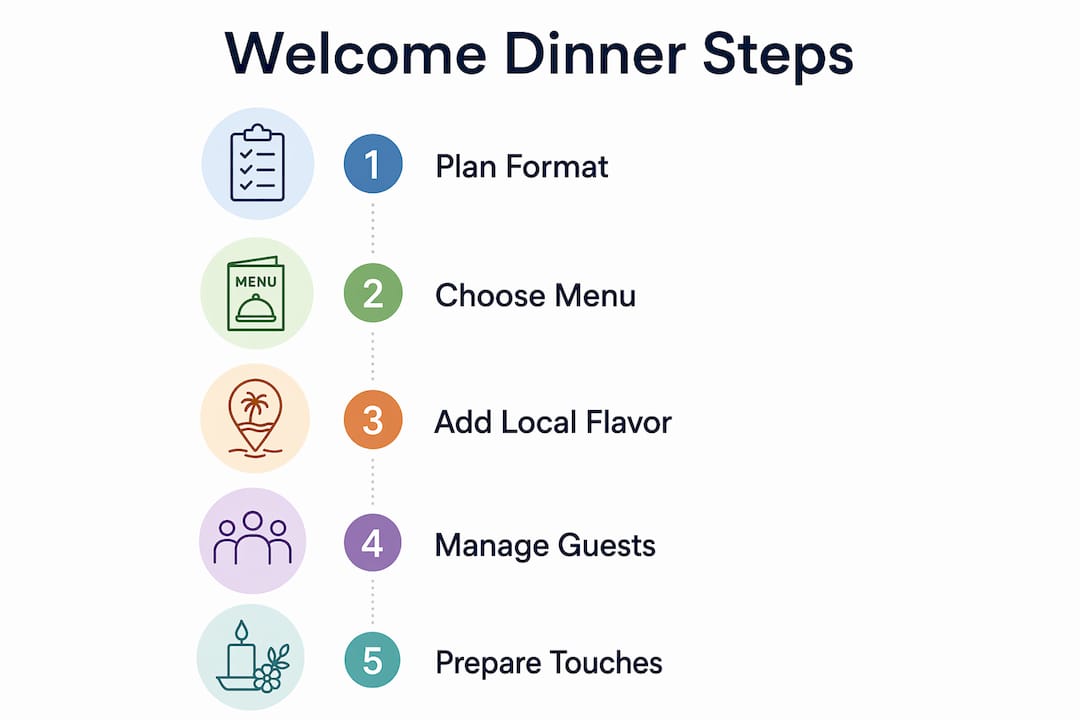
The most memorable welcome dinners don’t just happen to be in a beautiful place — they make the place part of the experience. And the good news is that infusing local flavor doesn’t require a big budget or months of extra planning.
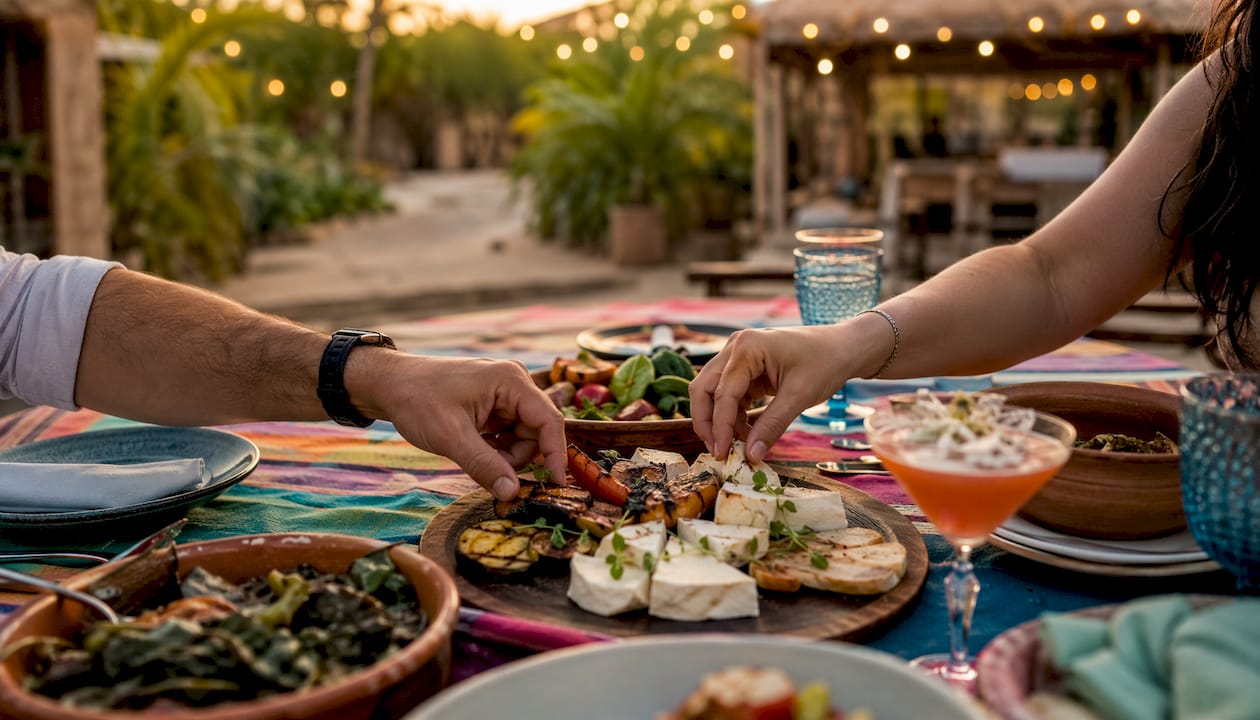
Food and drink are the easiest entry point. A signature cocktail built around a regional spirit (think Aperol in Italy, mezcal in Mexico, rum punch in the Caribbean) immediately signals “you are somewhere special.” Pair it with two or three local small plates — ceviche, arancini, conch fritters, whatever the destination does best — and guests feel the place before anyone says a word about it. Family-style platters of regional dishes work especially well for groups that don’t know each other yet, because sharing food is one of the fastest ways to break the ice.
Entertainment and activities can be light and still land hard. A local musician playing softly in the background, a short cultural demonstration (a brief flamenco performance, a Sicilian folk song, a local craft display), or even a regional tasting station doubles as an icebreaker. These touches give guests something to talk about and do, which takes the pressure off the couple to “work the room” all night.
Vendor sourcing from abroad is where a local planner earns their fee. When you’re planning from another country, ask your planner for vetted local caterers who have worked destination weddings before, and request a tasting or sample menu review before you commit. For cultural elements in weddings, a planner with deep local roots knows which vendors can deliver authentically and which are simply tourist-facing.
Quick local touches that travel well:
- Local snacks or a small regional food item in welcome bags (Sicilian almonds, Mexican hot sauce, Jamaican rum cake)
- A regional playlist curated by a local DJ or music service
- A small handmade craft or artisan gift that reflects the destination’s culture
- Printed cards in the welcome bag explaining the local specialty being served that evening
Who do you invite, and what are the etiquette rules?
The welcome dinner and the rehearsal dinner are two different events with two different purposes, and conflating them is one of the most common planning mistakes couples make.
Welcome party vs. rehearsal dinner: The rehearsal dinner is traditionally a smaller, more intimate gathering for the wedding party, immediate family, and close out-of-towners. It follows the ceremony rehearsal and tends to be more structured. The welcome party, by contrast, is open to all destination guests — it’s a social event, not a ceremonial one.
Guest list rules of thumb:
- Invite all out-of-town guests as a baseline. They’ve made a significant effort to be there, and the welcome event is your acknowledgment of that.
- Local guests are optional. If your wedding is in their city, they haven’t traveled, so there’s no obligation — though including them is always a kind gesture.
- When the invite is open to all guests, plan for 60–75% of guests attending. Local guests often skip, and some out-of-towners will arrive too late or too tired.
Communicating the guest list: If you’re keeping the welcome event smaller than the full wedding guest list, handle it quietly. A private note in your wedding website’s “Weekend Events” section (visible only to those with the link) works well. Avoid language that makes uninvited guests feel excluded — frame it as an intimate gathering for those who’ve traveled rather than a tiered event. Your wedding website content is the cleanest place to manage RSVPs and communicate timing without awkward conversations.
Who pays? Traditionally, the couple hosts and pays for the welcome event. In practice, parents or family members often offer to contribute, especially when the wedding is a destination event and the welcome dinner doubles as a family reunion of sorts. Accept graciously and give them a defined role (hosting a specific bar, covering the welcome bags) rather than a blank check.
What should you serve at a destination welcome dinner?
The food format you choose shapes the entire energy of the night. Professional planners consistently recommend heavy hors d’oeuvres or stations over plated dinners for welcome events, and the reasoning is straightforward: guests who are tired from travel don’t want to sit in assigned seats for two hours. They want to eat something delicious, move around, and meet people.
Format comparison:
| Format | Best for | Watch out for |
|---|---|---|
| Passed hors d’oeuvres | Cocktail-style events, smaller groups | Guests may not eat enough if pieces are too small |
| Food stations | Mixed arrivals, larger groups | Requires more staffing and space |
| Family-style platters | Intimate groups, long tables | Works poorly with staggered arrivals |
| Plated dinner | Small, close-knit groups with fixed arrival times | Rigid, hard to manage late arrivals |
Sample menus by venue type:
- Beachfront resort: Ceviche station, grilled seafood skewers, tropical fruit display, signature rum or tequila cocktail
- Villa or estate: Charcuterie and local cheese boards, bruschetta, arancini, regional wine and Aperol spritz
- Rooftop terrace: Mini sliders, flatbreads, mezze spreads, craft cocktails with local spirits
- Casual garden or BBQ: Grilled proteins, corn on the cob, coleslaw, local beer and lemonade
Dietary accommodations matter more at a destination welcome event than almost anywhere else, because guests can’t easily slip out to find an alternative. Label every station clearly (gluten-free, vegan, nut-free), and brief your catering team on the guest list’s restrictions before the event. A quick dietary survey in your RSVP form — two questions, handled through your wedding website — solves this entirely.
Budget ranges: Casual welcome parties typically run a moderate amount per guest depending on format and location. All-inclusive resorts can dramatically reduce or eliminate food costs, leaving only upgrades and extras to budget for.
Pro Tip: Set a clear food service start time and stick to it, even if a few guests haven’t arrived yet. Late-arriving guests can graze from stations without disrupting the flow — but guests who arrived on time shouldn’t wait an hour to eat.
How much does a welcome dinner cost, and who pays?
Budget ranges for a destination wedding welcome party vary more than most couples expect, largely because the venue type changes the math entirely.
Typical per-guest ranges:
- Poolside cocktail reception with light bites: $25–$45 per person
- Heavy hors d’oeuvres party at a private venue: $45–$65 per person
- Themed seated welcome dinner at an off-site location: $65–$80 per person
- All-inclusive resort event: often included or minimally priced as an add-on
Ways to reduce cost without losing impact:
- Limit the bar to beer, wine, and one signature cocktail rather than a full open bar. One planner suggests a ticket system for the first drink if a full open bar isn’t feasible.
- Host a dessert-and-drinks event rather than a full meal, especially if guests are arriving late and have already eaten.
- Use resort amenities (a pool deck, a beach area) rather than renting a separate private venue.
- Skip elaborate florals and high-end rentals. Simple candles, local greenery, and good lighting do more for atmosphere than expensive centerpieces.
Working with venue minimums: Many resort venues have food-and-beverage minimums for private events. Ask your planner to negotiate the minimum against the wedding weekend’s total spend, not just the welcome event in isolation. A planner with an existing relationship at the property will often get better terms than a couple negotiating directly.
Family contributions: When parents or in-laws want to contribute, give them a specific line item to own (the welcome bar, the welcome bags, the entertainment) rather than a general fund. It keeps the budget clean and gives them a sense of meaningful participation.
When should you hold the welcome event, and how do you plan the logistics?
Timing is where welcome events most often go wrong, and the fix is usually simpler than couples think.
- Schedule it the evening before the wedding, not two nights before. This gives guests who arrive the day before the ceremony a chance to settle in, and it keeps the welcome event close enough to the main event that the energy carries forward.
- Build in a flexible arrival window. A drop-in start (say, 6:30–7:00 PM) rather than a hard start time accommodates travel delays without making punctual guests wait.
- Keep the total duration to 2.5–3 hours. Guests need sleep before the wedding day. An event that runs past 10:30 or 11:00 PM on the night before the ceremony is a gift to no one.
- Coordinate with hotel check-in times. If your venue is off-site, confirm that guests will have had time to check in, freshen up, and get there. A 7:00 PM start works well for most destinations; 6:00 PM is often too early for guests arriving that afternoon.
- Arrange transportation. If the venue is more than a short walk from the hotel, provide a shuttle or clearly communicate rideshare options. Traffic on a Friday evening can catch couples off guard, as one planner notes, so build buffer time into the transport schedule.
- Plan a weather backup for outdoor venues. Identify a covered or indoor alternative before the event, not the morning of. Confirm the backup with your venue contract and brief your planner on the trigger conditions (light rain vs. storm).
Pro Tip: Set a published end time on the invitation and stick to it. Guests respect a clear close, vendors appreciate the certainty, and you’ll both thank yourselves the next morning.
For a full wedding planning checklist that covers the welcome event alongside every other pre-wedding task, Sicilianweddingandevent’s planning guide is a practical starting point.
What small touches make guests feel genuinely welcomed?
The details that guests remember most from a welcome event are rarely the expensive ones. They’re the touches that say “we thought about you specifically.”
Welcome bags are the single highest-impact low-effort gesture at a destination wedding. Distribute them at the party entrance rather than coordinating hotel-room delivery — handing them out at the event makes the bags a social object, something guests open together and talk about, rather than a one-off amenity left in a room. Include a printed weekend schedule, a local snack or small gift, a handwritten welcome note, and practical essentials (pain reliever, a small bottle of water, a local map or QR code to the wedding website).
Signage and seating cues matter more than couples expect, especially when guests don’t know each other. Clear directional signage from the hotel to the venue removes anxiety for first-time visitors. Name tags or table cards work well for groups of 50 or more where introductions would otherwise be awkward; for smaller, more intimate groups, they can feel overly formal and are often better skipped.
Activities that encourage mingling:
- A local tasting station (wine, spirits, or regional foods) with a brief description card gives guests a shared talking point
- A photo wall or simple photo booth with destination-themed props
- Lawn games (bocce, cornhole, pétanque) for outdoor venues
- A short cultural demonstration or live performance as a soft icebreaker
Accessibility and dietary labeling: Make sure the venue is physically accessible for all guests, and label every food station clearly. A guest who can’t eat anything at the welcome dinner will remember that long after the flowers have wilted. For couples planning curated destination experiences, the same attention to personalized detail that makes a proposal memorable applies directly to a welcome event.
A practical checklist and sample timeline for your welcome event
Use this as a working document to share with your planner and vendors.
Planning checklist:
- Confirm venue and negotiate food-and-beverage minimum
- Book catering and confirm menu with dietary accommodations
- Arrange bar service (open bar, limited bar, or ticket system)
- Organize transportation (shuttle schedule, rideshare info for guests)
- Order or assemble welcome bags and printed weekend schedules
- Arrange signage (directional, food station labels, welcome sign)
- Book entertainment (playlist, live performer, or cultural demo)
- Confirm staffing ratios with caterer (see planner advice section)
- Set up sound system check for background music
- Identify and confirm weather backup plan with venue
Sample timeline for a 2.5–3 hour welcome event:
| Time | Activity |
|---|---|
| 6:30 PM | Venue opens; staff in position; welcome bags at entrance |
| 6:30–7:00 PM | Guest arrival window; passed welcome cocktail |
| 7:00 PM | Food stations open; background music begins |
| 7:00 PM | Couple gives brief welcome remarks (2–3 minutes maximum) |
| 7:00–9:00 PM | Open mingling; stations replenished; bar active |
| 8:45 PM | Gentle wind-down signal (music softens, last call) |
| 9:00–9:30 PM | Guests depart; shuttle returns to hotel |
A note on welcome bag distribution: Handing bags out at the door is simpler and more social than hotel-room delivery. If some guests are staying at different properties, designate a table near the entrance where bags are sorted by name. For guests arriving after the event ends, coordinate with the hotel concierge for next-morning delivery.
Adapting for time zones and late flights: If a significant portion of your guests are crossing multiple time zones, consider a later start (7:30 or 8:00 PM) and a shorter duration. Guests arriving from long-haul flights often need an hour to decompress before they’re ready to be social, and a 2-hour event that starts later is better than a 3-hour event where the first 45 minutes are awkward.
What planners know about social flow that most couples don’t
The difference between a welcome event that guests talk about for years and one that just “happened” usually comes down to one thing: social flow. This means designing the space, the food service, and the timing so that guests move, mix, and connect naturally, rather than sitting in one spot all night waiting for something to happen.
In practice, social flow means stations instead of tables, passed food instead of buffet lines, and a layout where the bar, the food, and the seating are in different parts of the space. When guests have to move to get a drink, get food, or find a seat, they pass each other, make eye contact, and start conversations. A room where everything is in one place tends to cluster people in groups they already know.
Two patterns worth knowing:
A welcome event where the couple switched from a plated dinner to a heavy hors d’oeuvres format saw the energy in the room shift noticeably within the first 30 minutes. Guests who had been sitting quietly at assigned tables were suddenly moving, laughing, and introducing themselves. The food was the same quality; the format was the only change.
Conversely, a seated welcome dinner that started 45 minutes late (due to a delayed shuttle) left guests tired and slightly irritable before the first course arrived. By the time the meal ended, it was past 10:30 PM and the energy for the wedding day had already taken a hit.
Vendor tasks to request from your planner:
- Designated arrival contact on-site (a staff member who greets guests and directs them)
- Buffet or station staging confirmed 30 minutes before guest arrival
- Lighting adjusted for evening (warm, low light by 7:30 PM)
- Clear signage at every decision point (entrance, food stations, restrooms, exit to shuttle)
Pro Tip: Plan for one server per 25 guests and one bartender per 50 guests as a baseline. For a destination welcome event where guests are arriving tired and thirsty, erring toward one bartender per 35–40 guests makes a noticeable difference in the first hour.
Key Takeaways
A welcome dinner for destination weddings works best when it prioritizes guest comfort, social flow, and local flavor over formality or elaborate programming.
| Point | Details |
|---|---|
| Format drives energy | Heavy hors d’oeuvres or stations encourage mingling far better than a plated dinner for tired, travel-weary guests. |
| Timing is non-negotiable | Schedule the event the evening before the wedding, keep it to 2.5–3 hours, and set a published end time. |
| Guest list and attendance | Invite all out-of-town guests; plan for 60–75% attendance when the invite is open to everyone. |
| Budget per guest | Casual formats run $25–$80 per person; all-inclusive resorts can significantly reduce or eliminate food costs. |
| Sicilianweddingandevent | Offers full-service welcome-event design, vendor curation, and multi-day coordination for couples planning a destination wedding in Sicily. |
The welcome dinner detail most couples overlook
There’s a pattern that shows up again and again in destination wedding weekends: couples spend months perfecting the ceremony and reception, then treat the welcome event as an afterthought. They book it late, give it a minimal budget, and assume guests will be happy with whatever is available. Sometimes that works. More often, it sets a flat tone that takes the rest of the weekend to recover from.
What actually works, consistently, is an early food start, a space designed for movement, and at least one local accent that makes guests feel the destination. It doesn’t need to be expensive. A Sicilian arancino passed on arrival, a local musician playing softly in the background, a welcome bag with a handwritten note — these are the details guests mention when they describe the weekend to friends back home.
The pitfalls are equally predictable: a late start that leaves hungry guests waiting, a format so formal that no one relaxes, or a welcome event scheduled so close to the rehearsal dinner that the two events blur together and neither gets the attention it deserves. A local planner who knows the venue, the vendors, and the permit requirements removes most of these risks before they become problems. Logistics like transport timing, outdoor permits, and catering staffing are genuinely complex in a foreign destination, and they’re exactly the kind of detail that a specialist handles without the couple ever knowing it was an issue.
Planning a destination welcome dinner in Sicily? Sicilianweddingandevent can help
Couples who choose Sicily for their destination wedding often find the welcome event is where the magic of the place first lands for their guests. A clifftop terrace at sunset, a courtyard in a baroque estate, a private beach with a table set for 60 — these are the settings that make a welcome dinner feel like the beginning of something extraordinary rather than just a pre-party.
Sicilianweddingandevent, led by planner Tania Costantino, handles every element of the welcome event as part of its full-service wedding planning in Sicily: venue selection, vendor curation, menu design with local caterers, transport coordination, permits, and on-the-day staffing. The difference from planning alone is not just time saved — it’s the access to vetted local vendors, the relationships with venues that don’t advertise online, and the experience of having done this dozens of times in the same destination.
If you’re beginning to map out your wedding weekend in Sicily, the luxury wedding venues page is a good place to start imagining where your welcome dinner could take place. To discuss your full weekend vision and check availability, reach out to Tania directly through the services page.
Useful sources
These are the planning guides and editorial resources used to build this article. Each one is worth bookmarking for deeper research.
- Wedding Welcome Party Etiquette and Planning Advice | Vogue — Expert planner quotes on social flow, food formats, and the case for stations over seated dinners. Strong on the “why” behind format choices.
- Wedding Welcome Party Planning | Plan A Wedding — Practical scheduling guidance, attendance estimates, and welcome bag distribution tips. Useful for logistics and checklist planning.
- The Importance of a Welcome Dinner in Your Wedding Weekend — Bolen Bliss — Focuses on the emotional benefits of the welcome event and how it shapes guest experience across the full wedding weekend.
- How to Host a Destination Wedding Welcome Party | Destination I Do — Comprehensive planner-sourced advice on atmosphere, local flavor, guest list decisions, and logistics. One of the most detailed destination-specific guides available.
- Destination Wedding Welcome Party: Ideas & Planning Guide | TheWeddingPlanner.ai — Covers per-guest budget ranges, hors d’oeuvres quantities, and all-inclusive resort considerations.
- How to Plan the Ultimate Wedding Welcome Party | Brides — Practical advice on entertainment scale, playlist curation, and keeping the event conversation-first.
- Top Creative Ways to Get Your Destination Wedding Weekend Started | Destination Weddings Blog — Destination-specific themed welcome dinner ideas with regional menu examples and specialist planner perspective.
Recommended
- Italian wedding banquet: tradition, trends and budget – Tania Costantino
- How to Create an Authentic Sicilian Wedding Menu? | Tania Costantino – Sicilian Wedding and Event
- Traditional Sicilian wedding food you can’t miss – Tania Sicilian Wedding
- Master destination event coordination for Sicily weddings