


A luxury wedding is defined by three primary budget drivers: venue exclusivity, catering quality, and personalized design. Understanding these luxury wedding cost factors explained here gives you the clarity to allocate funds with confidence rather than guessing after contracts are signed. Luxury weddings typically start at $150,000 and can exceed $1 million for elaborate events. Venue and catering alone consume 45–65% of the total budget, and hidden costs add another 9–15% beyond what vendor quotes show. Knowing where the money actually goes is the first step toward a wedding that feels extraordinary without becoming financially painful.
What are the major luxury wedding cost factors explained?
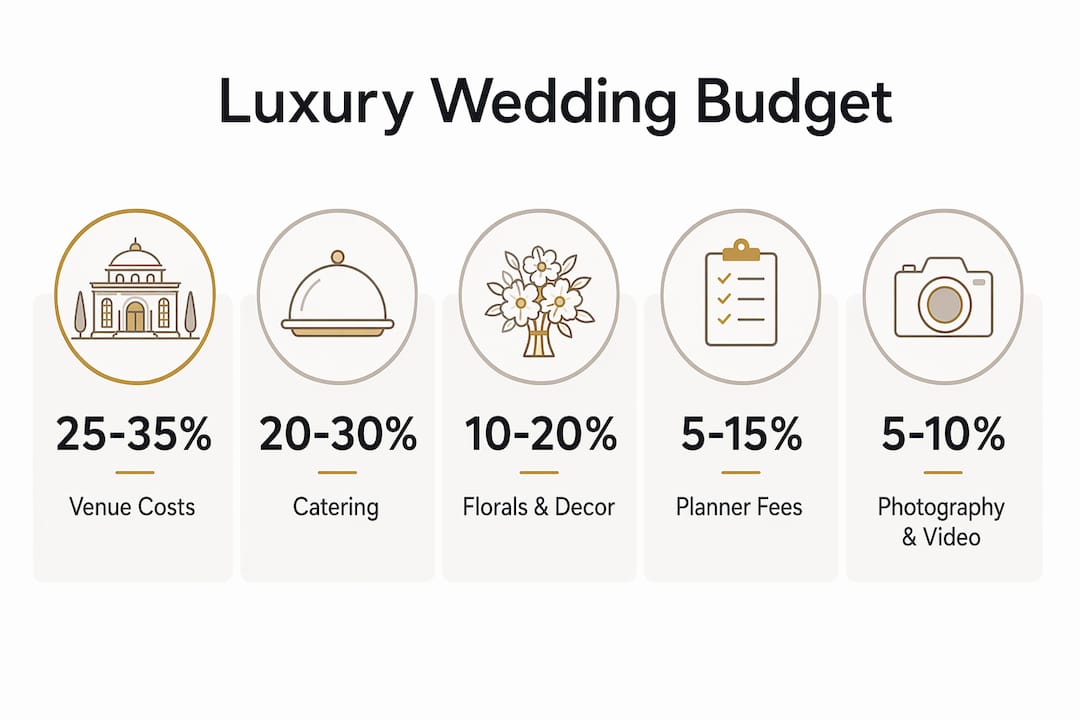
The luxury wedding budget breakdown follows a predictable structure once you know the categories. Venue, catering, florals, photography, and planning fees account for the vast majority of spending. Each category carries a wide range depending on your choices, guest count, and location.
Venue costs
Venue exclusivity and location represent the single largest variable in any luxury wedding budget. Historic estates, private villas, and five-star hotels range from $100,000 to $500,000 or more for full buyouts. Venue costs typically consume 25–35% of the total budget. A clifftop villa in Sicily, for example, carries a different price structure than a city ballroom, and that difference shapes every other vendor decision that follows. Explore luxury wedding venues in Sicily to understand how exclusivity translates into real pricing.
Catering and beverages
Catering is the second largest expense category, consuming 20–30% of the total budget. Premium menus with multi-course dining, curated wine pairings, and staffed cocktail hours drive costs significantly higher than standard banquet packages. High-end catering for a luxury event often means working with specialized vendors who source local, seasonal ingredients. Understanding festive meal offerings for events helps couples see what premium catering actually includes and why it costs what it does.
Florals, decor, and lighting
Florals, decor, and lighting together account for 10–20% of a luxury wedding budget. This category is highly variable because design choices range from simple elegance to elaborate installations. Lighting alone, including chandeliers, uplighting, and canopy string lights, can run $15,000 to $50,000 for a large venue. Custom floral arches, table centerpieces, and ceremony backdrops each add to the total. This is where couples most often overspend relative to the guest experience impact.
Photography, videography, and entertainment
Photography and videography typically represent 5–10% of the total budget. Luxury wedding photographers charge $8,000 to $30,000 or more depending on experience, team size, and travel requirements. Entertainment, including live bands, string quartets, and DJs, adds another layer of cost. A live band for a 150-person reception can cost $15,000 to $40,000. These vendors shape how the day is remembered, which makes them high-priority spending for most couples.
Planner fees and bridal fashion
Experienced luxury wedding planners charge 5–15% of the total event budget. On a $300,000 wedding, that means $15,000 to $45,000 for planning services. Bridal fashion, including the gown, alterations, accessories, and the groom’s attire, typically adds $5,000 to $30,000 depending on designer choices. These are fixed costs that couples often underestimate when building their first draft budget.
The table below summarizes typical budget allocations for a luxury wedding:
| Category | Budget Share | Typical Range |
|---|---|---|
| Venue | 25–35% | $37,500–$105,000+ |
| Catering and beverages | 20–30% | $30,000–$90,000+ |
| Florals, decor, and lighting | 10–20% | $15,000–$60,000+ |
| Photography and entertainment | 5–10% | $7,500–$30,000+ |
| Planner fees | 5–15% | $7,500–$45,000+ |
| Bridal fashion | 3–8% | $4,500–$24,000+ |
Pro Tip: Build your budget from the venue and catering numbers first. Every other category should flex around those two anchors, not the other way around.
What hidden costs can surprise couples in luxury wedding budgets?
Hidden costs are the most common reason luxury weddings exceed their original budgets. Unexpected expenses average $3,300 per couple beyond what vendor quotes show, and that figure rises sharply for destination events with multiple vendors. Knowing these costs in advance lets you build them into your plan rather than absorb them as surprises.
The most common hidden costs in luxury weddings include:
- Overtime fees. Overtime charges run $200 to $500 per hour per vendor. A reception that runs 90 minutes long can add $2,000 or more across your venue, catering team, and band.
- Service charges vs. gratuities. Service charges of 18–25% cover venue operational costs. They do not go to individual staff. Gratuities are separate and expected. Budget for both.
- Vendor meals. Most vendor contracts require that you feed your vendors. A team of 20 vendors at $50 per meal adds $1,000 before you notice it.
- Cake cutting fees. Many venues charge $3 to $10 per person to cut and serve a cake brought in from an outside bakery. On 150 guests, that is $450 to $1,500.
- Mandatory rentals. Rentals such as linens and lighting can add $10,000 to $75,000 beyond the base venue cost. Many venues list these as separate line items rather than including them in the quoted price.
- Permit and insurance fees. Destination venues, especially historic estates, often require event insurance and local permits that couples do not anticipate.
Hidden costs add 9–15% to total wedding spending beyond vendor quotes. That means a $200,000 quoted budget can become $218,000 to $230,000 at final invoice. A 10–15% contingency reserve built into your original budget absorbs these costs without stress.
Pro Tip: Ask every vendor for a fully itemized quote that includes service charges, overtime policies, and any mandatory add-ons before you sign. A clean quote prevents the most common budget overruns.
How do guest count, location, and timing influence luxury wedding costs?
Three levers control more of your final budget than any single vendor decision: how many guests you invite, where you hold the event, and when you schedule it. Adjusting any one of these three factors changes the cost structure of the entire wedding.
- Guest count is the strongest budget multiplier. Luxury weddings cost $1,500 to $2,000 per guest at the premium end of the market. A 200-person wedding at $1,750 per guest costs $350,000 in catering and rentals alone. Cutting the guest list from 200 to 120 saves $140,000 before you touch a single other line item. Guest count affects catering, seating, florals, favors, and venue capacity simultaneously.
- Geographic location sets the price floor. Venue and vendor costs vary dramatically by region. A private villa in Sicily carries different pricing than a ballroom in Manhattan or a resort in the Maldives. Destination weddings add logistical complexity, including travel coordination, local vendor sourcing, and import fees for specialty items. Working with a local wedding planner in Sicily eliminates the guesswork and reduces costly coordination errors that remote planning creates.
- Peak season and weekend pricing adds a meaningful premium. Saturday weddings in june, july, and august command the highest venue and vendor rates. Shifting to a Friday or Sunday in may or october can reduce venue costs by 15–25% without changing the guest experience. Off-peak scheduling also improves vendor availability, which means you access better talent at lower rates.
- Destination complexity adds logistical costs. International destination weddings require legal documentation, local vendor contracts in a foreign language, and logistics for guests traveling from multiple countries. These costs are real and often underestimated. Couples who plan destination weddings remotely without local support consistently overspend on coordination and last-minute problem-solving.
- Venue exclusivity determines your vendor options. Some exclusive venues require you to use their preferred vendor list. That restriction limits negotiation and can inflate costs by 20–30% compared to open-vendor venues. Always ask whether a venue has mandatory vendor requirements before signing.
What budgeting strategies and luxury wedding planning tips help control costs?
Controlling costs in a luxury wedding does not mean spending less. It means spending where it matters most and protecting your budget from waste. The couples who feel best about their final invoices are the ones who made deliberate choices early rather than reactive ones late.
- Prioritize 2–3 categories and let the rest flex. Choose the elements that matter most to you, whether that is catering, florals, or live music, and allocate generously there. Reduce spending on low-impact items like printed menus, elaborate favors, and excessive decor that guests rarely notice.
- Negotiate all-inclusive quotes. Negotiating all-inclusive catering packages prevents 20–30% budget creep caused by inflated line items added after signing. Ask for a single bundled price that includes service charges, staffing, and setup rather than accepting itemized quotes that grow with every revision.
- Book vendors early. The best luxury vendors, especially photographers and live bands, book 12–18 months in advance. Early booking locks in current pricing and prevents the premium you pay when you negotiate from a position of limited availability.
- Use a local planner for destination events. Trusting local experts is the most effective way to reduce logistical risk in destination weddings. A local planner knows which vendors are reliable, which venues have hidden fees, and how to navigate local regulations without expensive delays.
- Focus on guest comfort over design complexity. Thoughtful pacing and climate-appropriate hospitality create a more memorable experience than elaborate decor. Providing shade, fans, or warm wraps costs a fraction of a floral installation and guests remember it far longer. Learn how event design shapes luxury weddings to understand where design investment actually pays off.
Pro Tip: Reserve your contingency fund in a separate account from your main wedding budget. Couples who keep it visible and separate are far less likely to spend it on upgrades before the final invoices arrive.
Key Takeaways
Luxury wedding budgets are controlled by three primary drivers: venue exclusivity, catering quality, and guest count. Every other cost category adjusts around those three anchors.
| Point | Details |
|---|---|
| Venue and catering dominate spending | These two categories consume 45–65% of the total luxury wedding budget. |
| Hidden costs are predictable | Budget a 10–15% contingency reserve to absorb overtime fees, service charges, and mandatory rentals. |
| Guest count is the strongest multiplier | Reducing the guest list is the fastest way to lower total costs without sacrificing quality. |
| Service charges are not gratuities | Budget separately for both; service charges cover venue overhead while gratuities go to individual staff. |
| Local planners reduce destination risk | A local planner prevents costly coordination errors and vendor mismatches in destination weddings. |
What I’ve learned about luxury budgets after years in Sicily
Couples often arrive with the belief that a bigger budget automatically produces a better wedding. That belief leads to the most expensive mistakes I see. Luxury is defined by guest experience and seamless execution, not by the total invoice. A wedding with a $400,000 budget and poor timing, overloaded schedules, and uncomfortable guests is not a luxury event. A $180,000 wedding with thoughtful pacing, exceptional food, and a venue that takes your breath away absolutely is.
The couples who struggle most are the ones who try to manage a destination wedding remotely. They micromanage vendors through email, make decisions without understanding local customs, and then panic when logistics don’t align. The solution is not more spreadsheets. It is trusting the people on the ground who know the territory.
What guests remember is how they felt. They remember whether the food was extraordinary, whether they were comfortable, and whether the evening flowed naturally from one moment to the next. They do not remember the exact floral arrangement on table seven. Spending $30,000 on florals while cutting the catering budget is a trade-off that almost always disappoints.
My strongest advice is this: identify the two or three things that genuinely matter to you as a couple, invest there without apology, and simplify everything else. That approach produces weddings that feel personal, generous, and genuinely luxurious, regardless of the total number on the final invoice.
Planning a luxury wedding in Sicily with Sicilianweddingandevent
Sicily offers some of the most extraordinary wedding settings in the world, from baroque estates in the Val di Noto to clifftop terraces overlooking the Mediterranean. Sicilianweddingandevent, led by Tania Costantino, provides full-service luxury destination wedding planning for couples seeking an authentic, bespoke experience in Sicily.
Sicilianweddingandevent handles venue sourcing, vendor curation, event design, and on-the-ground coordination so you never have to manage logistics from across an ocean. Every detail, from the menu to the lighting to the ceremony flow, is tailored to reflect your vision. Explore the top wedding venues in Sicily or reach out directly to begin planning your day with a team that knows Sicily the way only locals can.
FAQ
How much does a luxury wedding typically cost?
Luxury weddings start at approximately $150,000 and can exceed $1 million for large, elaborate events. The final total depends primarily on venue exclusivity, guest count, and catering quality.
What percentage of a luxury wedding budget goes to venue and catering?
Venue and catering together consume 45–65% of the total luxury wedding budget. These two categories are the strongest drivers of overall cost and should be finalized before allocating funds to other vendors.
What are the most common hidden costs in luxury weddings?
The most common hidden costs include overtime fees ($200–$500 per hour per vendor), service charges of 18–25%, vendor meals, cake cutting fees, and mandatory rentals. These expenses add 9–15% beyond original vendor quotes.
How does guest count affect luxury wedding costs?
Luxury weddings cost $1,500 to $2,000 per guest at the premium level. Reducing the guest list is the single fastest way to lower total spending without reducing the quality of the experience.
Do I need a local planner for a destination wedding in Sicily?
A local planner is the most effective way to manage a destination wedding successfully. Local experts navigate vendor relationships, legal requirements, and logistics that remote planning consistently mishandles, reducing both cost overruns and day-of stress.