


A full-service luxury destination wedding planner handles your seating chart from the first design sketch to the final place card. That means the design concept, RSVP and dietary tracking, guest-to-table placement, printed signage, and day-of adjustments all live under one roof, with one person accountable for how it turns out.
For couples used to delegating important decisions to people who actually know what they’re doing, that’s the whole point. You shouldn’t be the one untangling which cousin can’t sit near which aunt at 9 p.m. the night before your welcome dinner in Taormina.
Here’s what that full scope typically includes:
- Design concept and moodboard that ties seating aesthetics to your overall wedding theme
- Floor-plan mapping with verified dimensions for your actual venue, not a generic template
- RSVP and dietary management collected and tracked as guests confirm
- Guest-to-table assignment built around family dynamics and social flow
- Printed charts and signage, produced and installed on-site
- Day-of placement and contingency handling when a guest cancels or arrives late
A well-run planning relationship also comes with proof it works: a documented process timeline, sample moodboards you can review before committing, and a portfolio of weddings actually delivered. Sicilianweddingandevent builds seating design into its full-service Sicilian wedding packages precisely because separating it out invites the kind of last-minute chaos that ruins an otherwise flawless event.
Key Takeaways
A full-service luxury planner turns seating from a logistics headache into a designed guest experience, backed by editable files, a firm timeline, and on-site authority to adjust on the wedding day.
| Point | Details |
|---|---|
| Start with the floor plan | Get a dimensioned venue layout before designing any table configuration. |
| Lock the guest list early | Aim for a final cutoff four to six weeks before the wedding to protect printing timelines. |
| Demand file ownership | Require a print-ready PDF, an editable master file, and a CSV export for vendors. |
| Grant day-of authority | Add an empowerment clause letting the planner adjust seating without calling you. |
| Choose a destination-tested planner | Sicilianweddingandevent designs seating as part of its full-service Sicilian wedding packages, with portfolio proof and on-site staffing included. |
Table of Contents
- What Does a Bespoke Seating Chart Service Actually Include?
- What Design Principles Shape a Luxury Seating Layout?
- When Should You Start Building Your Seating Chart?
- What Determines the Cost of a Bespoke Seating Chart?
- How Do You Choose the Right Planner for Seating?
- How Does Seating Actually Get Executed on the Wedding Day?
- How Did a Real Seating Layout Come Together in Sicily?
- Why Seating Deserves the Same Attention as Your Dress
- How Sicilianweddingandevent Handles Your Seating Design
- Sources
What Does a Bespoke Seating Chart Service Actually Include?
“Full-service” gets used loosely in wedding planning, and it’s worth pinning down before you sign anything. A genuine bespoke seating-chart service covers production and logistics as much as design.
The deliverables you should expect in writing:
- Floor-plan import and on-site dimension verification, so the layout matches the actual room, not an approximate sketch
- At least two or three layout options reflecting different social-clustering strategies
- RSVP and dietary-tracking integration that updates as responses come in
- A finished, print-ready seating chart plus individual table signage, produced and mounted
- Signage installation and guest escorting on the wedding day itself
Ownership of your files matters more than most couples realize going in. You should walk away with a print-ready PDF for display, an editable master file in case anything changes late, and a CSV guest-to-table export your caterer can use directly for meal counts. Destination wedding coordinators increasingly treat that CSV as the shared source of truth between the planner, caterer, and venue staff, which avoids the classic destination-wedding failure mode: three vendors working from three different guest lists.
Good planners also handle the handoffs you’d never think to ask about. The caterer gets meal counts by table. The venue gets dimensioned layouts for rentals. The stationer gets final table names and guest counts for printing. None of that should land on you three weeks before the wedding.
Pro Tip: Ask your planner to include an “empowerment clause” in your contract, giving them explicit authority to make minor day-of seating adjustments without calling you. It sounds small, but it’s the difference between enjoying your reception and fielding texts about a broken RSVP during your first dance.
What Design Principles Shape a Luxury Seating Layout?
Table shape isn’t a decorative choice. It’s social architecture. Planners who take this seriously are engineering how your guests actually talk to each other, not just where they sit.
Round tables encourage everyone to talk across the group, which is why they remain the default for reception seating meant to feel inclusive. Long banquet tables create visual drama, especially outdoors against a Sicilian coastline, but they tend to split conversation into parallel threads rather than one shared exchange. U-shaped configurations work best for smaller, more intimate gatherings, such as a rehearsal dinner where you want every face visible. A top table still solves a real problem: when formality and family visibility matter, it gives your wedding party and immediate family a clear, elevated point of focus, a dynamic wedding planners consistently point to when advising on table strategy.
Sightlines and centerpiece scale are where amateur seating charts fall apart. Oversized arrangements that block eye contact across a table undo the social design the shape was supposed to create. A workable rule: keep the distance across a table at roughly four feet or less so guests can hold a normal conversation without leaning or raising their voice.
Mixing shapes deliberately gives a room dimension. A cluster of rounds anchored by one long table for the wedding party creates visual variety while keeping the social logic intact. Coordinate this against your table-setting style so scale and shape work together instead of competing.
Pro Tip: If your venue has a striking backdrop, like a clifftop terrace, reserve the long table for that sightline and use rounds for the rest of the room. You get the drama without sacrificing conversation flow at every other table.
When Should You Start Building Your Seating Chart?
Destination weddings compress an already tight process, so timing discipline matters more here than for a local wedding.
The typical sequence runs: initial briefing and moodboard, receipt of the venue’s floor plan, draft layout options built around social clustering, one or two client review rounds, a final guest-list cutoff, production and printing, then file exports handed to every vendor before the on-site staging plan locks in.
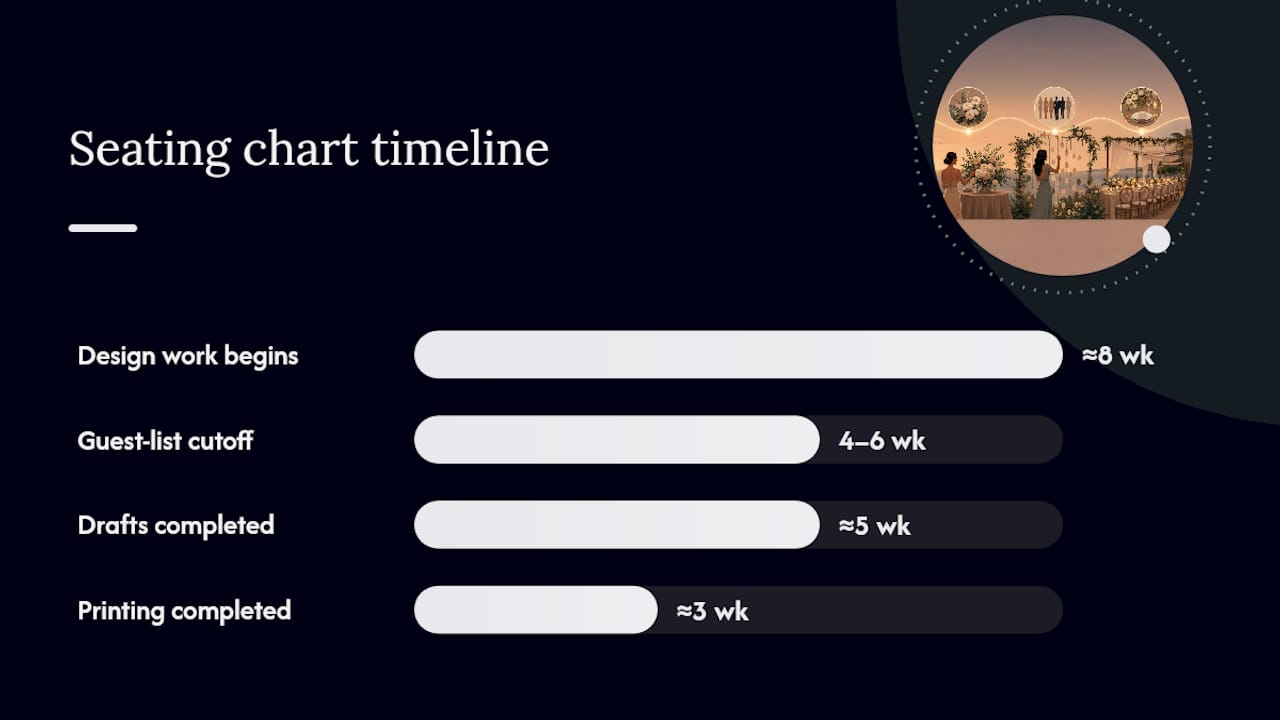
A published stationer example shows design work beginning about two months before the wedding, with the final guest list locked roughly four weeks out and printing completed around three weeks before the event, at a sample design fee of $500. For a destination wedding, build in extra buffer on both ends. Shipping mounted signage internationally or coordinating local printing in Sicily adds time that a hometown wedding doesn’t need to account for.
Multi-day destination events complicate this further. A welcome dinner, the reception, and a farewell brunch each need their own layout, not a single chart reused three times. Seating tools built for destination weddings recommend separate exports for each event specifically because guest counts and formality shift from one to the next.
Look for these milestones spelled out in your planner’s contract:
- Floor plan and moodboard delivered within the first planning weeks
- Guest-list cutoff four to six weeks before the wedding
- Draft layouts and revision rounds completed with two weeks of buffer before printing
- Final printed and mounted signage confirmed at least three weeks out
What Determines the Cost of a Bespoke Seating Chart?
Pricing on seating-chart design swings on a handful of concrete levers, and understanding them helps you read a quote instead of just reacting to the total.
Planner time is the biggest one: how many consultations and revision rounds are built into the fee before extra charges kick in. Design complexity comes next. An illustrated table plan, hand-drawn artwork rendering your actual tables and florals, costs more than a clean typographic layout, and illustration work is commonly priced per table, with published examples in the £25 to £40 range per table depending on detail level.
Materials and printing add another layer. A mirror-finish or foamboard-mounted chart in a common display size like A1 costs more than paper printed at home, but it also holds up to a full evening of guests crowding around it. Delivery and installation, especially for a destination wedding, can mean real travel costs if your planner or a specialist stationer is flying materials or staff to the venue.
| Cost Driver | Typical Structure | What to Watch For |
|---|---|---|
| Base design fee | Flat rate (example: $500) | Covers how many revision rounds? |
| Illustrated table plan | Per-table (roughly £25-£40/table) | Detail level affects final price |
| Mounting and materials | Flat, tied to size (A1 common) | Foamboard adds durability, adds cost |
| Delivery/installation | Flat or hourly, destination premium applies | Ask if travel is itemized separately |
| Rush or late changes | Often a surcharge | Confirm the cutoff before fees apply |
Rush changes are where quotes get expensive fast. If your guest list shifts after the printing deadline, expect a surcharge, and ask upfront what that number looks like rather than discovering it in an invoice. Review what actually drives cost across a full luxury wedding package before you compare seating quotes in isolation, since planners who bundle seating into full-service pricing sometimes offer better value than an à la carte stationer.
How Do You Choose the Right Planner for Seating?
The strongest signal of a planner’s real seating expertise isn’t their portfolio’s beauty. It’s whether their process survives contact with a destination wedding’s chaos: language barriers, shipping delays, and guests who RSVP three days before the event.
Look for destination-specific experience first. A planner who has staged three weddings in Sicily understands venue floor-plan quirks, local printing lead times, and vendor relationships that a generalist simply doesn’t. Ask to see a real seating-layout PDF and the CSV export they hand to caterers, not just a finished chart photograph. That distinction separates planners with an actual production process from those improvising each time.
Five questions worth asking in your first consultation:
- Who is physically on-site the day of the wedding, and what’s their seating authority?
- Can you show me a sample seating PDF and CSV export from a past event?
- How do you handle a guest cancellation two days before the wedding?
- What’s included in the design fee, and how many revision rounds come with it?
- Do we receive an editable master file, or only the final print-ready version?
Red flags tend to cluster together: vague pricing with no itemized breakdown, no willingness to grant day-of adjustment authority, and no clear file-ownership terms. If a proposal can’t answer what happens when a guest list changes at week three, it’s not built for a destination wedding’s realities.
Before signing, confirm your statement of work names the file formats you’ll receive, the number of revision rounds included, and who holds decision authority on the wedding day itself.
How Does Seating Actually Get Executed on the Wedding Day?
The wedding day itself is where all that planning either holds together or falls apart, and it’s entirely the planner’s job to make sure it’s the former.
The operational flow runs roughly like this: signage gets staged and checked against the final floor plan, guests are escorted to their tables as they arrive, and the caterer works from the CSV guest-to-table file rather than a printed list someone has to read aloud. A final sightline check, confirming nothing blocks a guest’s view across the table, happens before doors open.
Contingencies are where an empowered on-site team earns its fee. No-show guests, late arrivals from a delayed transfer, or a last-minute plus-one all require quick judgment calls, and a planner authorized to make them keeps you from fielding a single question during your own reception.
At the end of the night, you should receive a final seating master reflecting any changes made on the day, along with photos of the installed signage for your records. That documentation matters for reconciling final headcounts with the caterer afterward.
Your statement of work should specify:
- Who has authority to reseat a guest without contacting the couple
- How late arrivals or no-shows are handled at the table level
- What happens if a table’s seating shifts after signage is already printed
Pro Tip: Request a printed backup chart at the entrance in addition to individual escort cards. Guests lose small cards; they rarely miss a chart posted at the door.
How Did a Real Seating Layout Come Together in Sicily?
One couple planning a coastal celebration came to the table with a clear brief: they wanted a reception that felt like one long conversation, not a room full of separate dinner parties, but their venue’s terrace had an irregular footprint that made a single long table impossible without blocking the sea view for half the guests.
The solution mixed formats. A cluster of round tables filled the main terrace for open conversation. Meanwhile, one long table ran along the clifftop edge, reserved for the wedding party, framed against the water at golden hour. That single design decision solved both problems: it preserved sightlines for every guest and gave the wedding party a visually dramatic focal point without stranding anyone at a table facing a wall.
Guests told us afterward that the room felt intimate despite having over 90 people in it, because no one was more than a few feet from someone they knew. That’s what a deliberate layout does. It’s not decoration. It’s guest experience, built in advance.
That kind of layout maps directly to the seating design work included in Sicilianweddingandevent’s full-service planning packages, and it’s the same reasoning behind choosing a venue with your seating strategy in mind from day one rather than retrofitting it later.
Why Seating Deserves the Same Attention as Your Dress
Seating is the one design decision that actively shapes how your guests experience the entire night, and I think most couples underrate it until it’s almost too late to fix properly.
A moodboard tells you what your wedding will look like. A seating chart tells you what it will feel like, whether your grandmother ends up isolated at a corner table or seated where she can actually see the toasts, whether old friends who haven’t seen each other in years land at the same table by design rather than accident. That’s not logistics. That’s the guest experience itself, and it deserves the same design intention as your florals or your dress.
Handling family politics and dietary complexity gracefully requires real operational discipline: dietary flags tracked from the first RSVP, not scrambled together the week before, and an on-site team with the standing authority to solve small problems without interrupting your night. Couples who treat seating as an afterthought tend to spend their reception managing it themselves. Couples who build it into the design process from the start get to actually be at their own wedding.
How Sicilianweddingandevent Handles Your Seating Design
If you’ve been comparing a standalone stationer against a full-service planner, here’s the practical difference: a stationer produces your chart, but a full-service planner designs the social experience the chart represents and then executes it on-site, with nothing lost in translation between the design phase and the wedding day.
Sicilianweddingandevent offers seating design as part of its full-service Sicilian wedding packages, structured across design, production, and day-of management, so you’re never coordinating between three separate vendors for something this central to your reception. That includes the moodboards, floor-plan mapping, RSVP and dietary tracking, printed signage, and the on-site authority to handle whatever comes up while you’re busy actually enjoying your wedding.
You can review completed layouts and testimonials on the full-service planning page, or look through past events on the portfolio to see how table configurations played out in real venues. If you’re ready to talk through your guest list and venue constraints, request a consultation through Sicilianweddingandevent’s services page and start with a floor plan review before your guest-list deadline arrives.