


Most couples picture their destination wedding as an escape from everyday life. Sunlit terraces, intimate ceremonies, and the freedom to celebrate far from the usual obligations. But understanding why stress-free destination wedding matters goes far deeper than aesthetics. Nearly 70% of engaged couples experience negative mental health impacts during wedding planning, and destination weddings add logistical layers that can intensify that pressure significantly. This guide unpacks why protecting your peace throughout the planning process is not a luxury. It is the single most important thing you can do to actually enjoy the day you have been dreaming about.
Table of Contents
- Key Takeaways
- Why stress-free destination wedding planning matters for your well-being
- Unique stressors that destination weddings introduce
- Strategies for genuinely stress-free destination wedding planning
- How a relaxed wedding transforms the experience for everyone
- My honest take after years in destination wedding planning
- Let Sicilianweddingandevent take the weight off your shoulders
- FAQ
Key Takeaways
| Point | Details |
|---|---|
| Stress directly affects enjoyment | High planning stress reduces your ability to be present and savor the actual wedding day. |
| Destination weddings carry unique stressors | Legal paperwork, vendor coordination, and travel logistics add layers local weddings rarely face. |
| Professional support reduces mental load | Trusting experienced planners prevents the “invisible double workload” that causes burnout before the event. |
| Smaller guest lists improve the experience | Around 20 guests creates the intimacy and manageability that make destination celebrations truly memorable. |
| Presence beats perfection | A relaxed couple creates a warmer, more connected atmosphere for every single guest in the room. |
Why stress-free destination wedding planning matters for your well-being
Let’s be honest about what wedding planning actually does to people. Research shows that 70% of couples face mental health impacts during the planning process, with nearly 22% reporting significant effects. Only 13% said planning positively impacted their overall well-being. Those are sobering numbers for something that is supposed to be one of the happiest seasons of your life.
Wedding stress is not just a bad mood. Chronic stress keeps your nervous system in a sustained fight-or-flight state, which genuinely impairs decision-making and enjoyment. When your body is wired for threat detection, you stop being able to appreciate the good things happening around you. You second-guess vendor choices you already made. You lie awake replaying conversations with family members about table arrangements. That cycle does real damage.
“Stress management is about training your nervous system rather than eliminating stress entirely. Chronic productivity keeps the body in fight-or-flight, impairing both decision-making and enjoyment.” — AOL Wellness
The effects ripple outward, too. A couple visibly stretched thin sets the emotional tone for guests. People pick up on tension faster than they pick up on floral arrangements. When you are distracted by logistics on the morning of your ceremony, you are not fully arriving at the most important moment of the day.
Pro Tip: Schedule two or three “no-outcome hours” each week during planning where you do nothing wedding-related. It sounds counterproductive, but it actively resets the stress response and improves the quality of every decision you make afterward.
Here is what why stress-free wedding planning matters comes down to in practical terms. Your nervous system state on the wedding day is largely a product of the weeks and months before it. Managing stress as a professional skill means building habits and systems that keep the pressure at a manageable level throughout the process, not just hoping things calm down once the vendors are confirmed.
Unique stressors that destination weddings introduce
Here is the misconception that catches so many couples off guard. Choosing a destination wedding does not automatically reduce stress. It relocates it and sometimes multiplies it. The romantic backdrop comes bundled with logistical challenges that require deliberate planning to prevent them from overshadowing the experience.
Consider what you are actually managing when you plan a wedding abroad:
- Travel coordination for guests, including flights, airport transfers, and accommodation blocks
- Legal and administrative paperwork that varies by country and can be extensive (in Malta, for example, documentation must be submitted at least six weeks in advance, and post-Brexit classifications added complexity for UK couples)
- Vendor contracts in a foreign language or under unfamiliar legal frameworks, often including room-block penalty clauses that carry real financial risk without professional contract review
- Time-zone communication gaps with venues, caterers, florists, and photographers
- Guest uncertainty, including last-minute cancellations or travel complications that affect seating, catering counts, and accommodation bookings
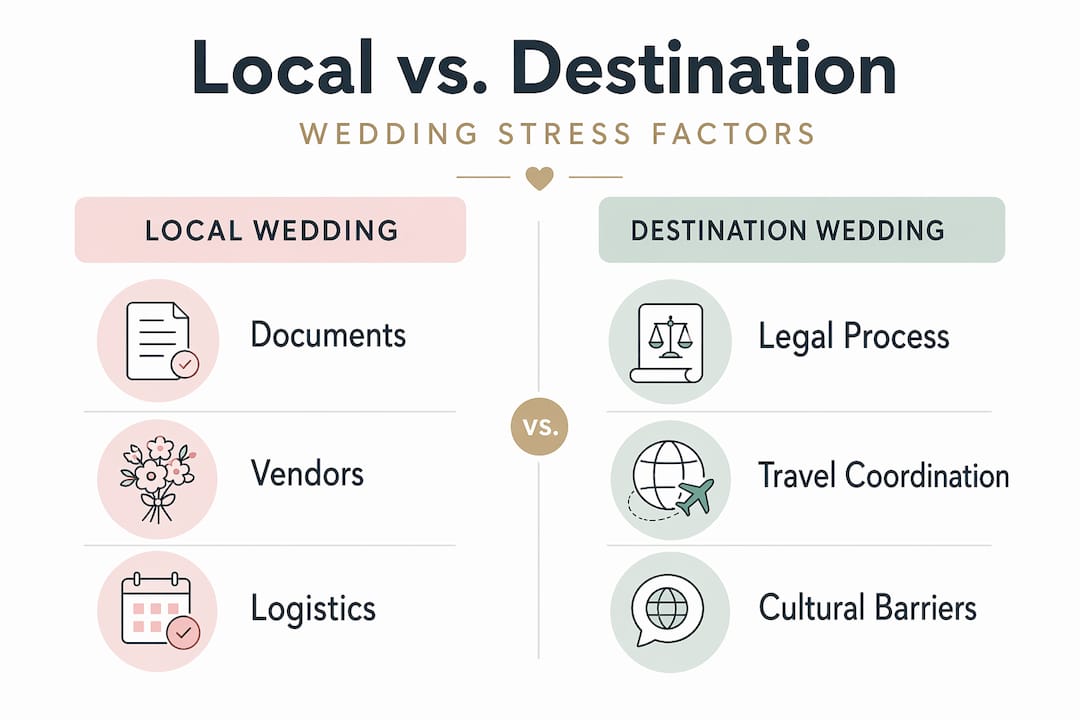
Here is a quick comparison of what couples typically face planning locally versus abroad:
| Planning factor | Local wedding | Destination wedding |
|---|---|---|
| Legal documentation | Standard marriage license | Country-specific requirements, deadlines, possible translations |
| Vendor coordination | Single city, familiar market | Multiple vendors across time zones, potential language barriers |
| Guest logistics | Guests manage their own transport | Couples often coordinate flights, hotels, and transfers |
| Contract complexity | Relatively straightforward | Room-block penalties, foreign law, cancellation clauses |
| Rehearsal access | Easy to visit venue multiple times | Often limited to one site visit or none before the event |
The importance of wedding location cannot be overstated here. Choosing a venue that handles most of these moving parts internally, rather than requiring you to manage a separate catering company, florist, and transportation service, changes the entire planning experience. A consolidated venue with experienced hosts dramatically reduces the number of decisions and relationships you need to manage simultaneously.
Strategies for genuinely stress-free destination wedding planning
Knowing the risks is only useful if you have a clear path forward. Here are the approaches that actually work, drawn from real planning experience and research on reducing cognitive load through smarter decisions.
- Choose a venue that consolidates services. An all-inclusive venue managed by experienced hosts removes the vendor coordination problem at its root. Couples using such venues report significantly lower anxiety throughout planning and on the day itself. When catering, décor, accommodation, and ceremony space are all under one roof and one contact person, you remove dozens of potential failure points.
- Work with a destination-specialist planner from day one. A local expert who knows the legal requirements, the best vendors, and the seasonal rhythms of your chosen location is worth every penny. They do not just save you time. They carry knowledge you simply cannot acquire from the internet in the weeks between your engagement and your wedding.
- Set your guest list intentionally and early. Around 20 guests is widely recognized as the sweet spot for destination weddings, balancing genuine intimacy with logistically manageable numbers. Every additional guest adds accommodation variables, catering confirmations, and seating decisions. Commit to a number you are comfortable coordinating and protect it.
- Align on values before making any vendor decisions. Decision fatigue is a real and documented phenomenon that hits hardest when couples have not agreed on priorities. If one partner cares about the view and the other cares about the food, every single vendor conversation becomes a negotiation. Spend an hour writing down your top three non-negotiables before you look at a single venue website.
- Build buffer time into your timeline. Destination weddings run on the unexpected. A ferry delay, a floral delivery held at customs, a photographer stuck in traffic on unfamiliar roads. A schedule with ten-minute buffers at every transition does not feel different to guests, but it absorbs the shocks that would otherwise cascade into visible chaos.
- Delegate completely, not partially. The hidden stress trap that burns most couples out is what researchers call the invisible double workload. You hand a task to a vendor or family member, then mentally redo it yourself because you are not sure they will get it right. That doubles your cognitive load without producing better outcomes. When you hire a professional, practice actually letting go. Use a detailed wedding checklist to track what is in whose hands and then step away from those items.
Pro Tip: Have one dedicated weekly check-in with your planner rather than responding to every question as it comes. Batching communication reduces the constant drip of decision-making that creates mental exhaustion.
How a relaxed wedding transforms the experience for everyone
There is something profoundly different about attending a wedding where the couple is genuinely at ease. You feel it the moment you arrive. The atmosphere is warm rather than tense. The ceremony feels intentional rather than hurried. The whole day has a quality of spaciousness that you cannot manufacture with a bigger budget or better flowers.
Smaller guest lists at destination weddings do something specific and measurable: they allow for personalized touches and surprise experiences that larger events simply cannot accommodate. A private cooking class the evening before the ceremony. A guided tour of a local village. A sunrise breakfast for the wedding party. These are the moments guests talk about for years, and they are only possible when the guest count and the planning infrastructure can support them.
Holding all wedding events at a single site also changes how guests experience the celebration. When everything is in one place, social time increases naturally and travel-related stress drops significantly. There is no shuttling between venues, no confusion about where to go next, no guests arriving late because they got lost between the ceremony and the reception. The flow of the day feels effortless, which is exactly what you want people to feel.
Here is the thing about why stress-free planning matters beyond your own mental health. Your guests came to celebrate you. They want to see two people who are genuinely happy, present, and connected. When you are absorbed by logistics or visibly tense, the people who love you feel that. They worry about you. The celebration loses its warmth. A relaxed couple is not just better for their own enjoyment. It is the single biggest gift they can give every person in the room.
“Stress-free weddings come from intentional decisions that simplify rather than eliminating all challenges. Presence beats perfection.” — Bryson B Photo
My honest take after years in destination wedding planning
I want to share something I have seen play out over and over again in this work. Couples spend enormous energy trying to make their wedding perfect. The right flowers, the right music, the right lighting at golden hour. And I understand that impulse completely. But what I have learned is that the couples who look back on their wedding day with the most joy are almost never the ones who achieved perfection. They are the ones who felt free.
Free to laugh when something unexpected happened. Free to hold each other during the ceremony without mentally running through the reception timeline. Free to actually taste the food they spent months selecting with their caterer.
The most overlooked stressor I see in destination wedding planning is the assumption that once the big decisions are made, the stress will naturally decrease. It rarely does unless you have systems in place to protect your mental state in the final weeks. I always recommend couples read through what to do the week before their wedding with their planner present, because that week is where anxiety peaks and where good preparation makes the most visible difference.
My contrarian take: less planning is sometimes genuinely more. Not fewer decisions made well, but fewer decisions made at all. When you trust your venue, trust your planner, and trust the process you have set up, you give yourself permission to stop managing and start experiencing. That shift is everything.
Let Sicilianweddingandevent take the weight off your shoulders
Planning a destination wedding in Sicily is one of the most beautiful things you can do. It is also one of the most logistically complex. At Sicilianweddingandevent, Tania Costantino and her team specialize in turning that complexity into something you never have to carry alone.
From vendor curation and contract review to legal coordination, travel logistics, and full event design, every service is built to reduce your mental load while creating an experience that feels authentically yours. Whether you are envisioning a baroque estate in the Val di Noto or a clifftop terrace above the Mediterranean, the team handles the details so you can focus on the person standing across from you. Start with the complete planning checklist to map your timeline, or explore the full range of destination wedding services in Sicily to see what a truly supported planning experience looks like.
FAQ
Why does stress-free wedding planning matter so much?
High stress during wedding planning directly reduces your ability to be present on the day itself. With nearly 70% of couples reporting negative mental health impacts, protecting your well-being throughout the process is the foundation of a genuinely joyful wedding.
Are destination weddings more stressful than local weddings?
They can be, yes. Destination weddings introduce unique challenges including foreign legal requirements, vendor contracts under unfamiliar laws, guest travel coordination, and communication across time zones. Without professional support, these layers multiply the planning burden significantly.
What is the ideal guest count for a destination wedding?
Research points to around 20 guests as the sweet spot. This number supports genuine intimacy, keeps logistics manageable, and allows for the personalized touches that make destination celebrations truly memorable.
How does hiring a wedding planner reduce stress?
A destination-specialist planner carries local legal knowledge, vendor relationships, and logistical expertise that couples cannot easily replicate. They also prevent the “invisible double workload” pattern by taking ownership of tasks completely, rather than creating a situation where couples mentally manage everything twice.
What is the single most impactful thing couples can do to reduce wedding stress?
Choose a venue that consolidates services under one experienced team. All-inclusive venues with expert hosts remove the majority of coordination stress at the source and consistently produce lower anxiety levels for couples throughout both planning and the event itself.