


Every couple marrying in Italy as foreign nationals needs four essentials: a valid passport, Nulla Osta or Certificate of Legal Capacity to Marry, proof that any prior marriage has legally ended, and certified translations with legalization where Italy requires it. Your very first move should be contacting the Comune where you plan to marry, or your home country’s consulate in Italy, to confirm exactly which form applies to your nationality.
TL;DR:
- Most couples should obtain their Nulla Osta or certificato di capacità matrimoniale well in advance, as processing times can delay the wedding by several weeks.
- If your country is a signatory to the Munich Convention, the certificate of capacity might avoid legalization steps, reducing bureaucratic delays.
- Legalization procedures differ: apostilles are sufficient for Hague Convention countries, while non-members require more time-consuming consular legalization.
- Translation errors and incorrect legalization are the main causes of document rejection, so using a court-approved sworn translator significantly improves approval chances.
- Planning the wedding date around the document posting period and document validity limits is crucial to avoid last-minute postponements or cancellations.
Table of Contents
- What documents do you need for a foreign marriage in Italy?
- Nulla osta or certificate of capacity: which one is yours?
- Legalization, apostille, and translation: what actually applies
- Publications and timing: how long before you can actually marry
- Special cases that commonly cause delays
- How a wedding planner actually helps with the paperwork
- Why the paperwork, not the ceremony, decides your wedding date
- Get Hands-On Help With Your Italian Wedding Paperwork
- Sources
What documents do you need for a foreign marriage in Italy?
Getting your documenti matrimonio stranieri Italia in order starts with knowing what the Ufficio di Stato Civile actually wants to see, not what you assume they want. Municipal offices across Italy are consistent on the basics, even when local procedures differ slightly from comune to comune.
Here’s the core list to gather before you ever book an appointment:
- Valid passport or national ID, plus at least one photocopy of the page with your photo and personal details.
- Nulla Osta or certificato di capacità matrimoniale, depending on your nationality (more on which applies to you below).
- Birth certificate or extract, especially important if your Nulla Osta doesn’t already list your parents’ names, since many comuni require that detail cross-checked.
- Divorce decree or spouse’s death certificate, if you’ve been married before, translated into Italian and legalized according to the rules for your document’s country of origin.
- Proof of residence or permit details, when relevant to your situation. Irregular immigration status does not automatically prevent a civil marriage in Italy, though it can complicate the paperwork trail.
- Extra certified copies, generally two to three sets, since the Comune, the consulate, and your own records each need a version.
Translation certification matters just as much as the documents themselves. A translation without the correct sworn or certified status is treated the same as no translation at all by most registrars. If your ceremony calls for an Atto Notorio, you’ll also need two witnesses present, and Italian registrars are strict about date formats, so double check that every certificate reads day, month, year, not the American month first convention. The municipal checklist from Comune di Milano is a useful real-world model, even if you’re marrying elsewhere in Italy, since most comuni mirror its structure closely.
Nulla osta or certificate of capacity: which one is yours?
The two documents solve the same problem through different routes, and knowing which one your country issues saves weeks of confusion. The Nulla Osta is a certificate stating you’re legally free to marry, typically issued by your home country’s authorities or your consulate. The certificato di capacità matrimoniale is a parallel document available to citizens of countries that signed the Munich Convention of 1980, and it comes with a built in advantage.
Countries party to the Munich Convention can issue a certificate that is generally exempt from legalization and commonly valid for a limited period, according to guidance from the Ministero degli Affari Esteri.
That exemption matters because it skips an entire bureaucratic step other nationals have to complete. A handful of European countries fall under this convention, so it’s worth checking directly rather than assuming your passport doesn’t qualify.
Practical steps to take:
- Identify which document your nationality requires by checking your consulate’s own website first, not a generic wedding forum.
- Request the document at least two to three months before your intended wedding date, since processing times vary widely by consulate.
- Ask specifically whether your document will need Prefettura legalization once it reaches Italy, because that step trips up more couples than any other.
Legalization, apostille, and translation: what actually applies
This is where couples lose the most time, and it’s almost always avoidable with the right sequence. If your country is a Hague Apostille Convention member, an apostille stamp on your document is usually sufficient. If it isn’t, you’ll need full consular legalization instead, a more involved process that takes longer and often requires an extra visit to your embassy.
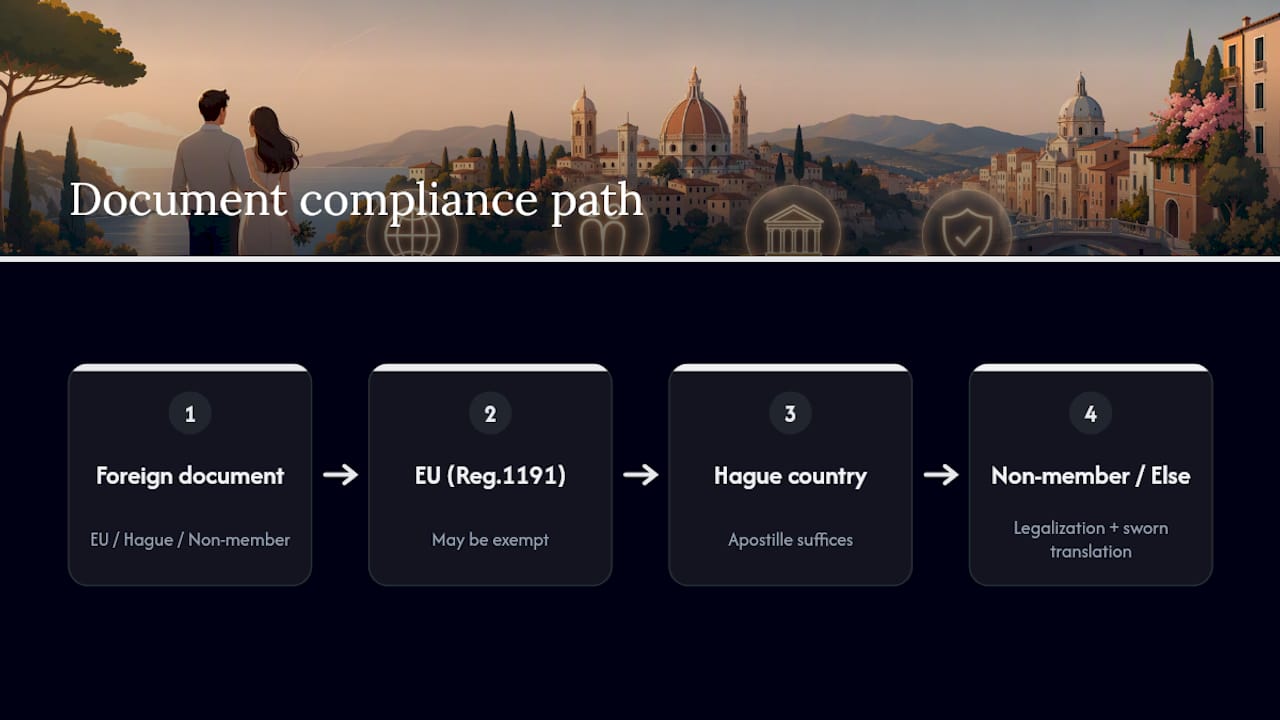
Regulation (EU) 2016/1191 simplifies things further for documents issued within the European Union, exempting many public certificates, like birth and marriage records, from both legalization and, in some cases, translation requirements entirely between member states.
For everything outside that exemption, sworn translation into Italian is mandatory, and the translator’s certification (or in some cases their signature) may itself need legalizing before the Comune will accept the paperwork. This is exactly the kind of detail that causes rejection, since errors in translation and legalization are consistently cited as the leading cause of document rejection by Italian civil registrars.
Pro Tip: Book your sworn translator through an Italian court-approved list (tribunale) rather than a generic agency abroad. Comuni trust these translations far more readily, and it removes an entire round of back and forth.
Publications and timing: how long before you can actually marry
Once your documents are legalized and translated, the Comune posts your pubblicazioni, the public notice announcing your intended marriage, and Italian law sets firm minimums here.
- Minimum posting period: at least 10 days, and the window must include two Sundays, a detail many couples overlook when booking their venue date.
- Earliest ceremony date: you can marry only after the pubblicazioni period closes, so count backward from your wedding date, not forward from your appointment.
- Document validity check: most capacity documents, including the Nulla Osta, are commonly treated as valid for a limited period, per the Comune di Milano’s own municipal guidance, so a document issued too early can expire before your ceremony.
- Filing appointment: bring originals plus copies of every certificate, and confirm your exact ceremony date only once the Comune formally accepts your file.
Consular postings for couples marrying abroad follow a related rule, with banns typically posted for a minimum of eight days when a consulate handles the notice instead of an Italian comune.
Special cases that commonly cause delays
A few situations deserve extra planning time because they don’t follow the standard path.
- Refugees unable to obtain documents from their country of origin can often use a substitute declaration instead, under ministerial guidance issued specifically for these cases.
- Irregular immigration status does not automatically block a civil marriage, though a refused Nulla Osta has occasionally required legal remedy through the courts in past cases.
- Divorced or widowed within 300 days of a prior marriage’s end may need specific court authorization before a new marriage can proceed, a rule aimed at avoiding paternity disputes.
- U.S. citizens needing an Atto Notorio should expect a consulate appointment requiring two independent witnesses, and scheduling delays of eight to twelve weeks are common in busier consular districts.
- Missing parent details on a Nulla Osta often means an extra birth extract is needed, so request one alongside your main capacity document rather than after a rejection.
If you’re not fluent in Italian, arrange an interpreter for both the filing appointment and the ceremony itself. Registrars will not proceed without one if communication genuinely breaks down.
How a wedding planner actually helps with the paperwork
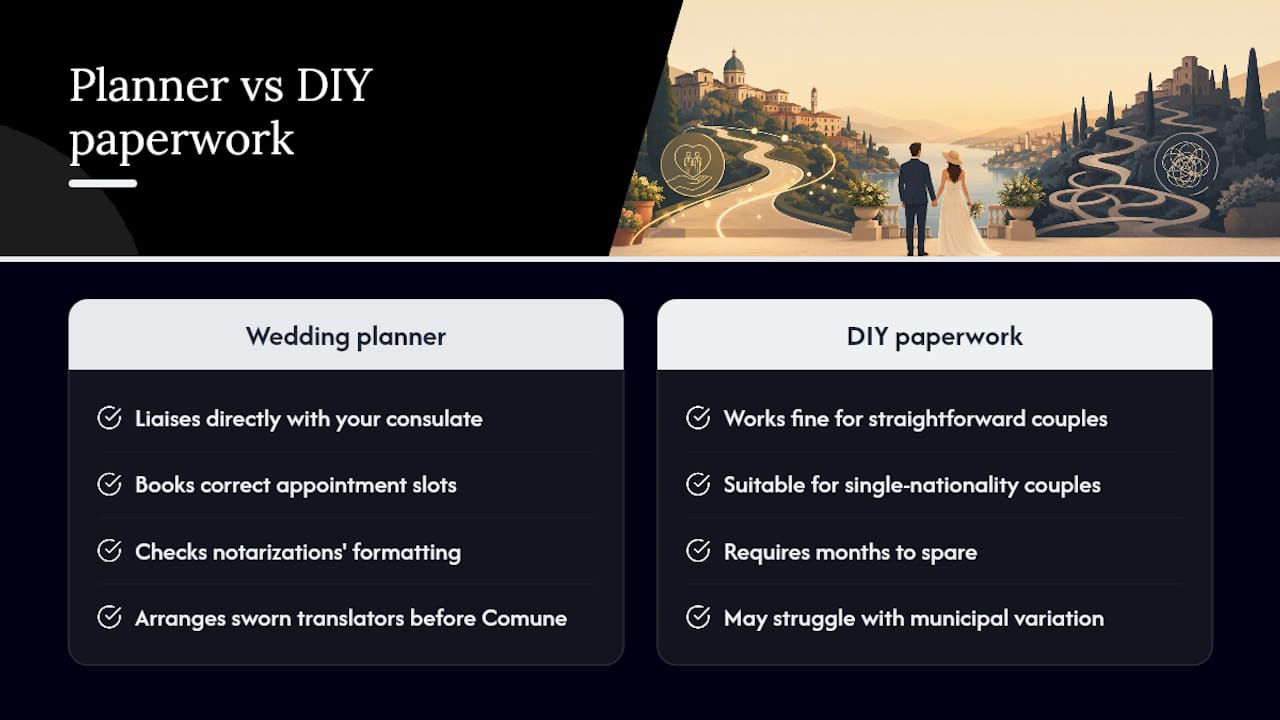
A planner familiar with Italian civil procedure handles the parts that eat the most time: liaising directly with your consulate, booking the right appointment slots, checking that notarizations are correctly formatted, and arranging sworn translators before anything reaches the Comune. Municipal variation is real. A small comune near a coastal venue may process requests very differently than Milan’s larger office, and a planner who already knows both systems closes that gap. DIY paperwork works fine for straightforward, single-nationality couples with months to spare. A tight timeline, a mixed-nationality couple, or a remote venue is when hiring help earns its cost.
Why the paperwork, not the ceremony, decides your wedding date
The biggest misconception couples bring to me is that choosing a venue or a date comes first. It doesn’t. Document timelines dictate everything else, and the couples who struggle most are the ones who booked a cliffside terrace for June before confirming their Nulla Osta’s issuing timeline in February.
Conventional wedding advice treats paperwork as an afterthought, a box to check once the “fun parts” are settled. That’s backwards for Italy specifically, where a six-month validity window on your capacity document, a mandatory ten-day posting period, and consulate appointment backlogs can each independently push your date by weeks. Stack two of those together and you’ve lost your season.
My honest read: request your capacity document the moment you set a rough date, not after you’ve picked flowers or a photographer. Everything else in wedding planning is flexible. Italian civil registration timelines are not. Treat the Nulla Osta or certificate of capacity as the first booking you make, and the rest of the planning gets dramatically easier.
Get Hands-On Help With Your Italian Wedding Paperwork
Chasing consulate appointments, sworn translators, and Prefettura legalization from another country is genuinely harder than it looks on paper, and it’s a common source of stress in couples planning a wedding in Sicily. A professional wedding planning service can handle that coordination directly, liaising with consulates and municipal offices so you’re not learning Italian bureaucratic timelines while also picking a venue. Our luxury destination wedding planning service folds document tracking into the same process as venue booking and event design, so nothing falls through the cracks between the two. If you want a clear starting point, our wedding plan to-do list lays out exactly what to tackle first. Reach out for a consultation and let’s get your paperwork timeline mapped against your ideal wedding date before either one locks you in.
Sources
- Marriage – Ministero degli Affari Esteri e della Cooperazione Internazionale
- Documentazione Matrimonio in Italia per Cittadini Stranieri — Comune di Milano (PDF)
- Documents required for the marriage — Cinformi
- Integrazionemigranti